
The City of Arts and Sciences: Valencia in science-fiction mode
Hemisfèric, science museum, Umbracle, Palau de les Arts and Oceanogràfic: how to visit Valencia’s City of Arts and Sciences, what’s free, what you pay for, and our tips.
Also available in Español · Nederlands · Français

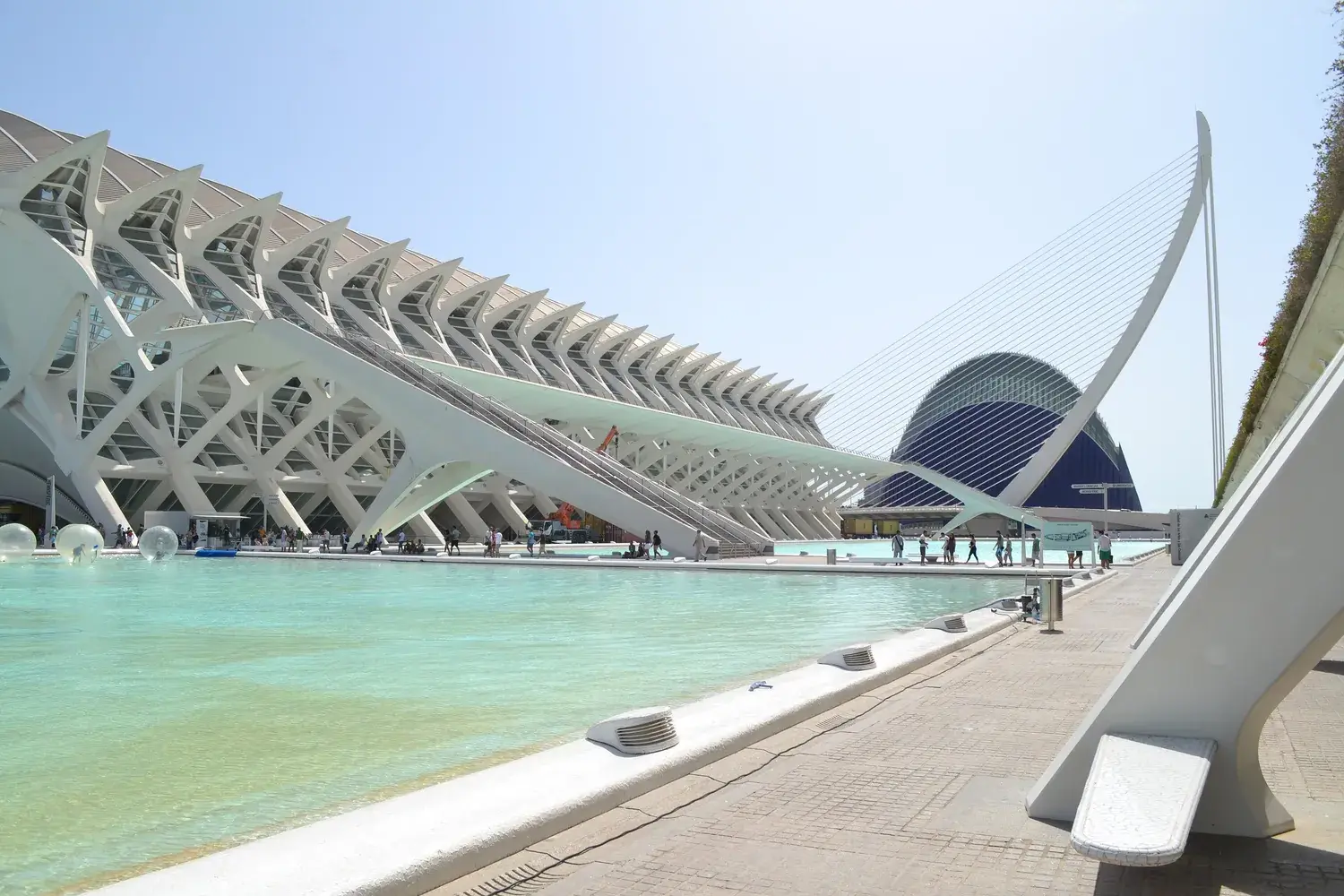
Some places you visit; others you stare at open-mouthed before you have even bought a ticket. The Ciutat de les Arts i les Ciències firmly belongs in the second group. Set in the old bed of the Turia, the river diverted after the great flood of 1957, it lines up nearly two kilometres of white buildings that look as if they have stepped out of a science-fiction film — a dream of concrete, glass and ceramics largely designed by Valencian architect Santiago Calatrava.
The good news: much of the City can be enjoyed for free, simply by strolling between the pools.
The buildings, one by one
The Hemisfèric was the first to open, in 1998. Its shape evokes a giant eye whose eyelid opens and closes; inside, a huge hemispherical screen shows documentaries and planetarium sessions.
The Museu de les Ciències looks like the skeleton of a giant whale. It is a museum where not touching is forbidden: hundreds of hands-on exhibits about science and technology, perfect for curious children… and for parents who never quite understood static electricity.
L’Umbracle is a long garden promenade under white arches, planted with Mediterranean species and dotted with contemporary sculptures. It is one of the best viewpoints over the whole complex — and it is free.
The Palau de les Arts Reina Sofía, with its huge metal ‘plume’, is Valencia’s opera house. L’Àgora, at the far end, completes the ensemble, as does the Assut de l’Or bridge with its tall white pylon.
Finally, the Oceanogràfic, whose sail-shaped roofs were designed by Félix Candela, houses Europe’s largest aquarium. It deserves half a day on its own, so we have given it a full article.


What’s free and what you pay for
Free: the outdoor walk, the gardens of l’Umbracle, the areas around the buildings and the views from the bridges. You can easily spend an hour or two here, especially late in the afternoon when the golden light makes the trencadís (ceramic mosaic) sparkle.
Paid: inside the Museu de les Ciències, the Hemisfèric screenings and the Oceanogràfic. Combo tickets are usually the best value.
Our tips
Come twice if you can: once during the day for the museums, and once at sunset for the walk and photos. The City completely changes character with the light.
Arrive on foot or by bike through the Turia gardens from the historic centre: it is the loveliest way in, along a green corridor several kilometres long that crosses the whole city.
Hat and sun cream: between the white buildings and the water, the glare in summer is intense.
What next?
For a full day with children, follow our Valencia with kids itinerary: Gulliver park just nearby, Bioparc, Malvarrosa beach. And if it rains, the science museum and the Oceanogràfic top our rainy day selection.


